


Front and Center: Michael Woody
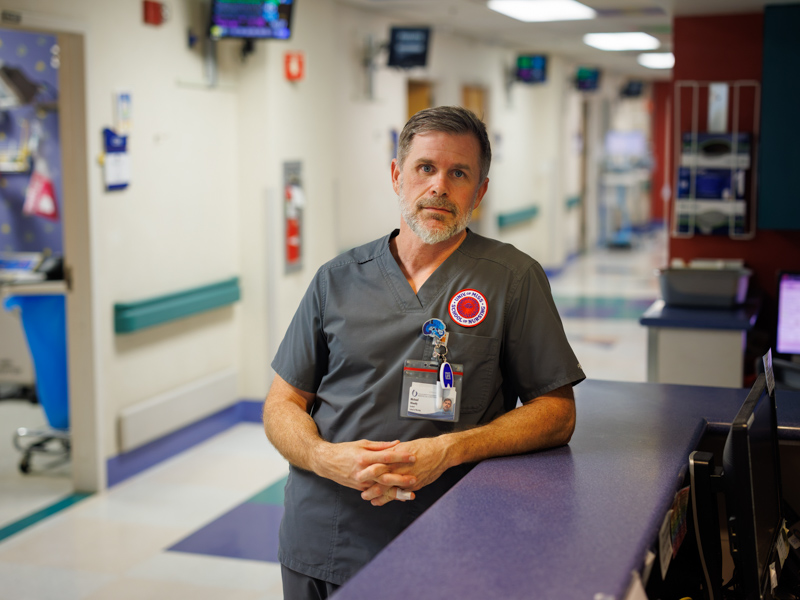
In his previous life, Michael Woody, a student in the UMMC School of Nursing, was part artist, part caretaker.
Back then, his “patients” were some of his own paintings and sketches, forged of the very best acrylics and graphite and other tools of the trade. Others were some of the most expensive pieces of art.
“I worked as a preparator at the Andrew Kreps Gallery in New York City for almost three years and lived in New York for almost 10 years altogether,” Woody said. “My job was to handle, hang and ship artworks, plus a lot of exhibition design and installation. It’s an in-demand job, as not just anyone can properly handle and hang a $20,000 painting, a $200,000 painting or in some cases a $2 million painting. I once also handled an $11 million Jasper Johns work and two works by Picasso valued in the tens of millions of dollars.”

In a few more weeks, the caretaker will turn to caregiver when he completes a career switch few of his contemporaries in art – or Woody himself – could have seen coming a few years ago.
The affable 49-year-old Vicksburg native will be pinned during the School of Nursing’s Jackson Accelerated Bachelor of Science program ceremony Dec. 3, after which he expects to take the National Council Licensure Examination, which grants the registered nurse license. The BSN program prepares students to enter graduate study at the master’s degree level if they choose to do so.
Easing back into student life isn’t uncommon with participants in the accelerated program, which is comprised of people with bachelor’s degrees in other fields who want to pursue nursing careers. Woody holds two master of fine arts degrees, one in painting from Savannah College of Art and Design and a second in new media from the University of Illinois.
What makes his career arc impressive to nursing faculty is a genuine enthusiasm for learning that’s as priceless as some of the artwork he used to handle.

“We talk often about nursing being both an art and a science,” said Dr. Jennifer Hargett, director of the Jackson Accelerated BSN program. “Clinical knowledge and technical skills are essential, but the ability to communicate with compassion and put patients at ease is equally important. Michael has a natural ability to connect with patients and build rapport, which are things you simply can’t teach in a classroom.”
He’s also communicated well across generational lines among younger peers in a fast-paced curriculum, no small feat for a nontraditional student.

“The patience and humility Michael has shown in stepping outside his comfort zone, accepting feedback and continuing to build his clinical confidence has been especially rewarding to witness,” said Dr. Kenisha Davis, an instructor in the accelerated program.
A Vicksburg native and avid outdoor adventurer, Woody traces the path of his new life back to a general need to connect more with the world, plus a few key moments the past decade, including a health scare and a curious moment of peace in the Andes mountains of South America.
“The life of an artist is very isolated,” he said. “It’s such a niche life. You spend eight to 10 hours a day in an art studio just working things out. In the art world, it’s easy to get into a really tight, cloistered headspace. I reached a point where it was time to get out of the studio and move back into the world.”
In 2017, while living in New York, melanoma was discovered on one of his legs. Surgery to remove it was a success, but he had precious little time to process it mentally – just two days later, he started his preparator job with the art gallery.
“It involved more than just burning off a little piece,” he said. “It was then I learned people in medicine are people like the rest of us. They won’t always know everything. Sometimes making assessments is like divining for water; you want a good doctor doing that divination. And the same is true for a nurse.”
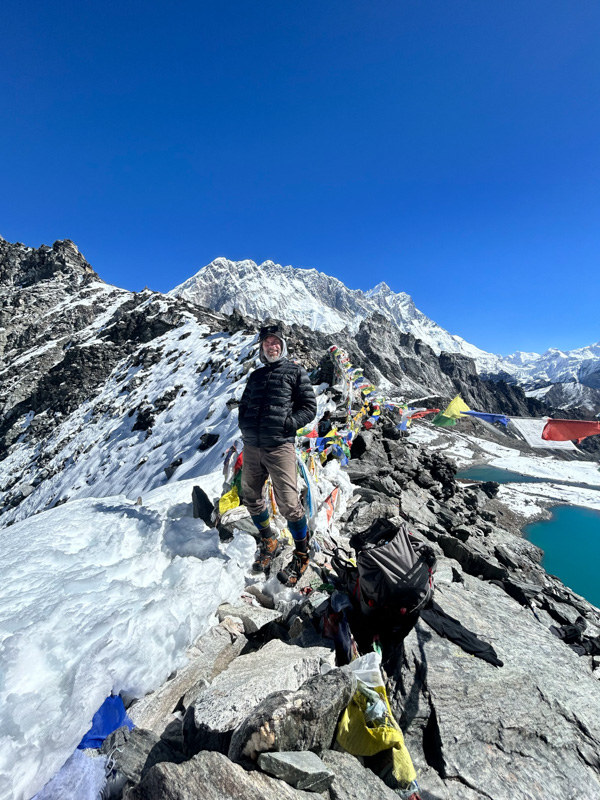
He had largely stopped painting by the time he moved to Santa Fe, New Mexico, in January 2020. Barely two months later, the COVID-19 pandemic began and effectively ended his gallery job. It started a five-year “run to the mountains” that became a self-discovery tour to places even experienced hikers wouldn’t dare venture – including the Khongma La Pass in Nepal, near the southern foot of Mount Everest.
“By 2024, I made it to Everest Base Camp, which is an 18,500-foot elevation, and to Mount Parinacota, in Bolivia near the borders of Chile and Peru,” he said. “In those years, I started to meet traveling nurses who worked in handling some pretty extreme cases, like people with frost burns who couldn’t take their own gloves off and people who didn’t make it up the mountain. I felt a palpable sense of responsibility they carried.”
The hike up Parinacota in Bolivia meant spending his nights in a shantytown as money and supplies got short. Whereas most people would have a panic attack in that moment, Woody found the peace he needed in order to guide the rest of his life.
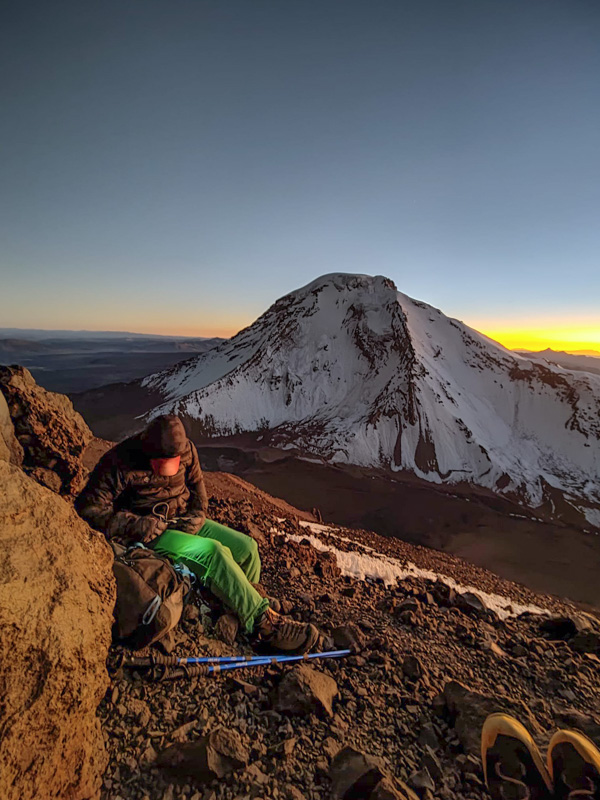
“It was a feeling of absolute peace and was the deepest, most profound silence that came over me,” he said. “I hadn’t felt this since I was a child. Inside that silence, the only thing that occurred to me was that I should become a nurse. It’s hard to say where the feeling came from. It was a shocking surprise. The wild thing wasn’t just hearing the message, but having the courage to take that leap.”
Since entering the program in January, he’s become adept at parts of becoming a nurse that don’t always come easy to those with zero health care background – mainly giving IVs and injections, accurate charting and time management – all while keeping the itch to hike properly soothed.
In May, he and his Australian shepherd, Maggie, were marooned in the southern Rockies for a few days when a late-season winter storm dumped about four inches of ice on the ground while the two were tent camping near Santa Fe.

“I’ll miss hearing stories like those and Michael’s sense of humor once he completes the program,” said Dr. Kathleen Rhodes, a professor in the accelerated program. “The experiences he shares reflect his adventurous spirit, his independence and an ability to adapt when faced with unexpected challenges.”
His plans after this semester suggest he won’t be trading in his heavy coats and hiking boots despite the new skill.
“I’m nearly 50, but I’m just now figuring out how to live. It’s sort of like jumping off a cliff and building your parachute on the way down – stories high, without a net, just like going through nursing school,” he said. “I’d love to go back to the mountains when I’m done and work aboard helicopters doing emergency rescues.”