


Advanced 3D technology and interdisciplinary care restore quality of life for Mississippi patient
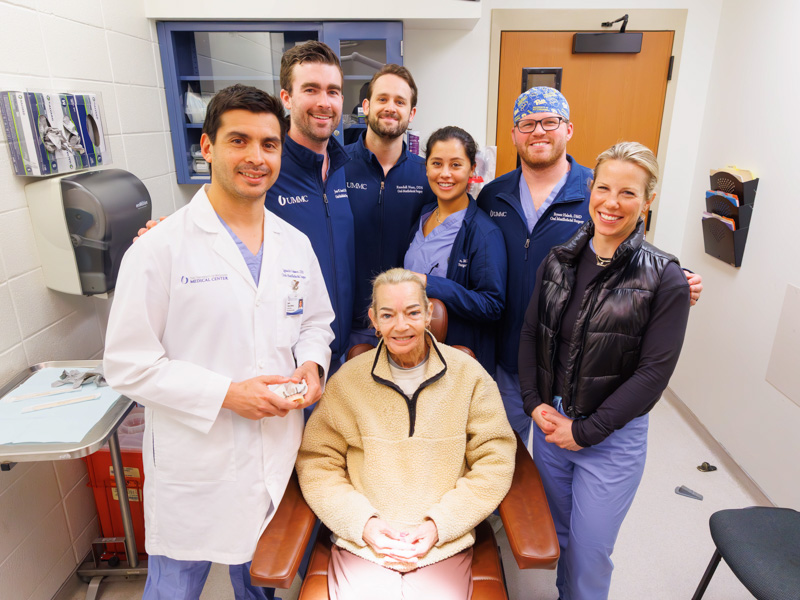
At the University of Mississippi Medical Center, a team including Dr. Ignacio Velasco, associate professor of oral and maxillofacial surgery, and Dr. Laura Humphries, associate professor of plastic surgery, took on a case that others said was impossible — giving Dawn Hoge her smile back.
The care plan involved advanced surgical procedures and the latest in 3D technology, marking the first bi-maxillary implant in Mississippi.
After surviving oral cancer, losing her teeth and enduring multiple surgeries, Hoge adapted. She relearned how to eat, how to speak and how to move through the world without smiling.
“I didn’t have teeth for five years,” Hoge said. “I got very good at eating with my gums.”
What began as a small, persistent sore in 2020 led to a diagnosis of squamous cell carcinoma in the floor of her mouth. Treatment saved her life, but the aftermath brought its own challenges. Hoge, like 4-8% of head and neck cancer survivors, later developed osteoradionecrosis, a condition in which radiation damages the jawbone, causing it to deteriorate.
“I went to five different doctors, and they all told me there was nothing they could do,” she said. “I finally wound up at UMMC, where I should have been all along.”
First came a complex reconstruction. After Velasco removed the dead bone from her lower jaw, Humphries transplanted bone, tissue, an artery and a vein from Hoge’s shoulder blade to reconstruct it.
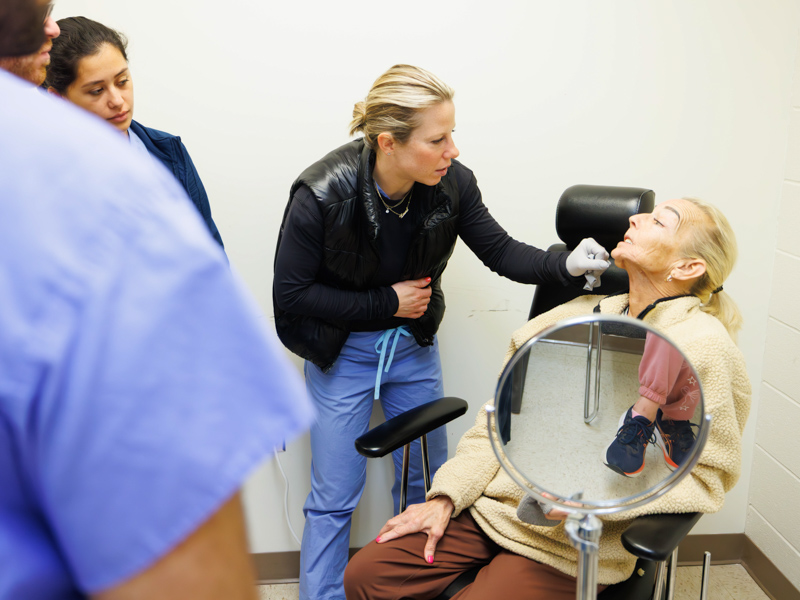
“This is called a “free flap,” Humphries explained. "I take tissue from one part of the body along with an artery and a vein – in this case, a part of the scapula and the skin of the back – disconnect it from the back, move the tissue to its new location, and connect blood vessels to an artery and a vein in the neck to get this tissue to live in its new location. It is a transplant of tissue within one’s own body.
“It’s a delicate and complex procedure because it involves harvesting multiple different types of tissue all connected on one vascular pedicle and connecting the vessels under the microscope. This procedure allowed us to help resolve pain she was experiencing from the necrotic bone, restore her jaw line and provide a stable scaffold around which the dental implants could be reconstructed.”
Whenever possible, in reconstructive surgery, surgeons try to restore and rebuild parts of the body with other like-tissue, replacing bone with bone, skin with skin, etc. In this situation, Humphries used bone from the shoulder blade and skin from Hoge’s back to reconstruct her jaw.
But even after that 13-hour surgery, Hoge still faced a life without teeth.
“After cancer treatment and radiation, the natural bone often loses its ability to heal and support traditional hardware,” Velasco said. “When you add the complex, irregular contours of a reconstructed jaw, standard solutions simply do not fit.
“Traditional dentures require a stable, consistent bone ridge to ‘sit’ on. And standard implants require drilling into the bone. But her new scapula bone in her jaw was unable to support traditional dental implants.”
In January 2026, Velasco and the UMMC team performed the state’s first bi-maxillary case using a fully customized, 3D-printed subperiosteal implant system. Unlike traditional implants that anchor into bone, this system uses a patient-specific titanium framework that rests on top of the jawbone, designed using CT imaging and CAD/CAM technology.”
This technology allows for ‘virtual surgery,’ Velasco said. “Instead of making adjustments during the operation, we use 3D digital models to design an implant that is patient specific. This 3D-printed titanium framework fits the patient's unique bone structure like a custom puzzle piece, ensuring a level of precision that was previously impossible."
This is the first time the high-tech, 3D-printed IPS version has been used in Mississippi to reconstruct both the upper and lower jaws simultaneously, he said.
While subperiosteal implants have existed for decades, earlier versions were prone to failure due to poor fit. Today’s 3D-printed approach transforms that concept by offering exact customization, improved stability and significantly reduced complications.
For Hoge, the results were immediate.
“She walked into surgery without teeth and walked out with a functional, beautiful smile,” Velasco said.
The success of Hoge’s case reflects the strength of coordinated, highly specialized care.
Her journey required seamless collaboration across oral and maxillofacial surgery, plastic surgery and prosthodontics, with each step building on the last.
“The earlier reconstruction created the physical foundation,” Velasco said. “While that surgery replaced the missing bone, it didn’t provide teeth. The earlier surgery created the ‘stage,’ and the custom 3D-printed IPS system provided the ‘performance’ — the teeth themselves.
For patients like Hoge, these advances are life-changing, allowing her to regain confidence immediately after surgery.
“I don’t mind smiling now,” she said. “For years, I covered my mouth anytime I smiled or spoke to someone. To go so long without teeth and then to wake up and suddenly have them, I felt like a different person.”
This approach offers a new path forward for patients once considered untreatable.
“It proves that our team can utilize patient-specific 3D printing to solve the most complex cases right here,” Velasco said. “We took a classic surgical concept and revitalized it with 3D printing and anatomy-specific customization, proving that we can now tailor medical devices to the patient, rather than forcing the patient to fit the device.”
For Hoge, the outcome is both deeply personal and something she hopes will help others.
“I want people to know this is possible,” she said. “Be your own advocate. Keep searching, because there is somebody out there that’s going to tell you ‘yes.’”