


‘Lucky Threes’ distinguish Class of 2029
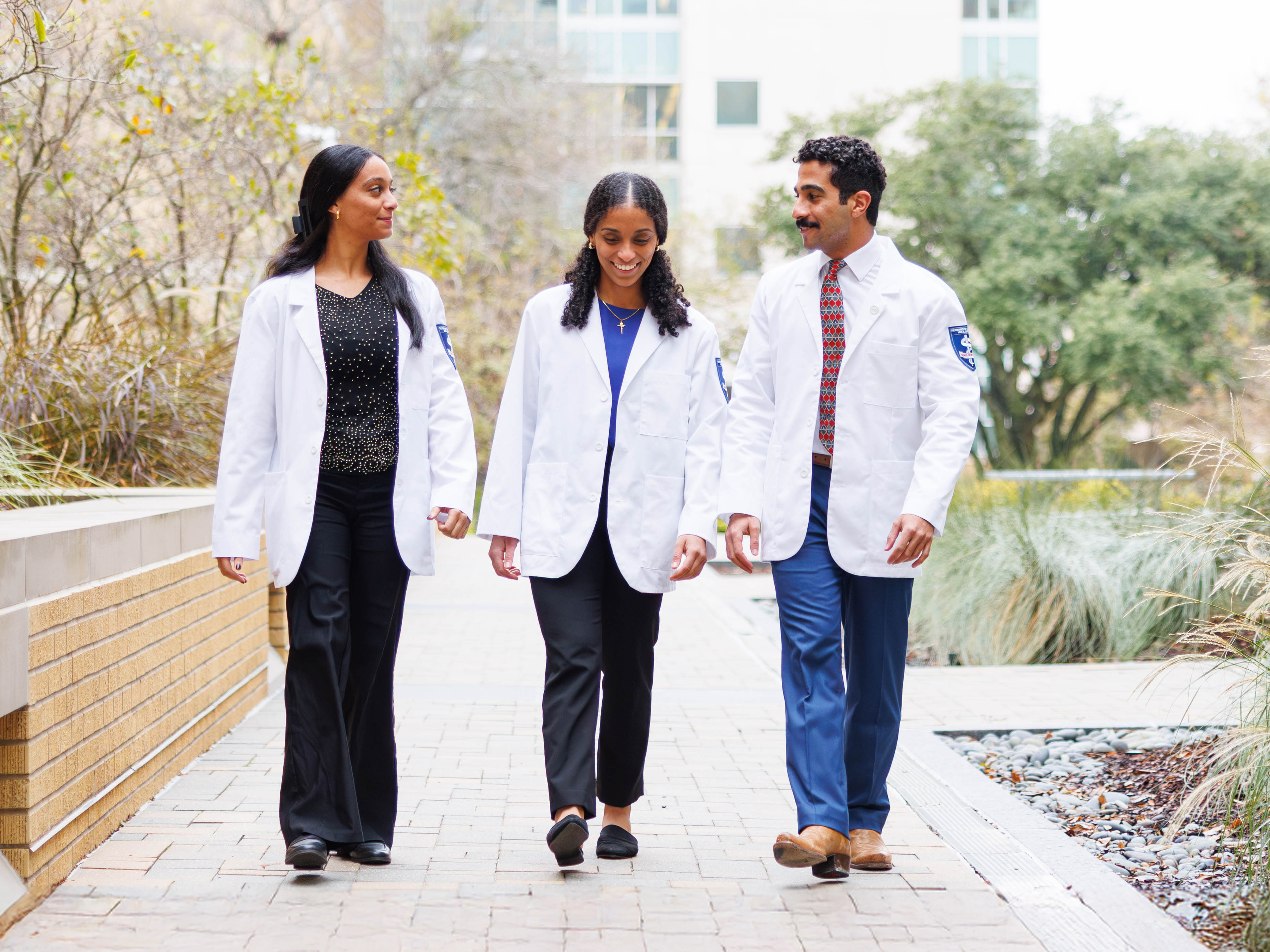
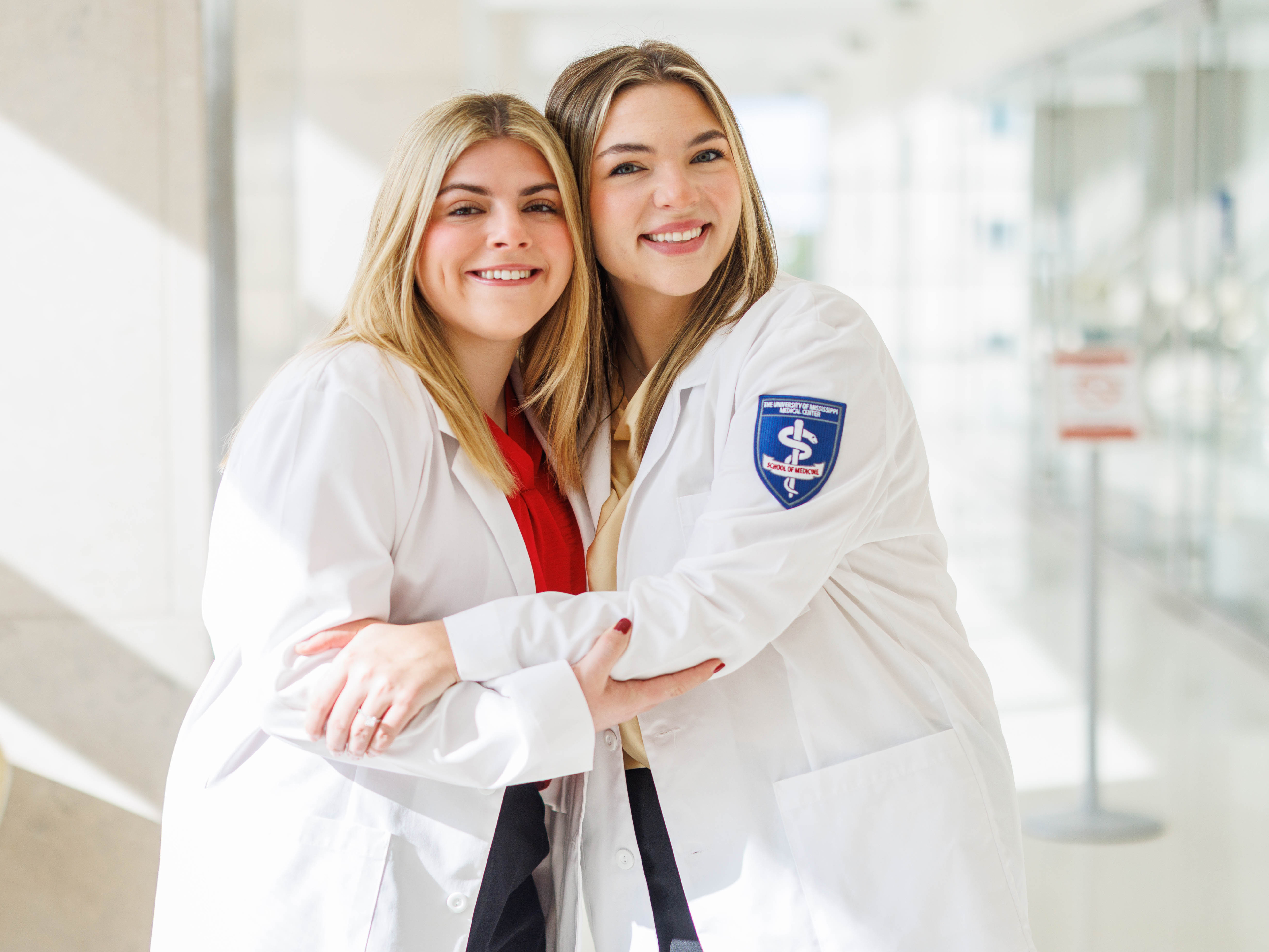
In the case of Michael, Sarah and Elizabeth Basha, the marvel that is the birth of a baby was magnified by three.
By nine, in fact, bearing in mind that when they were born, on Oct. 16, 2002, they were three months early.
“It’s kind of a miracle that we came out OK,” said first-born Elizabeth Basha, a toaster-sized 3 pounds at birth, while Michael and Sarah each came in at 2 lbs. 2 ½ oz., or slightly heavier than a quart of milk.
The triplets’ singularity has more layers: All are first-year medical students at the University of Mississippi Medical Center, having applied and earned admission at the same time – six years later than Dr. Michelle Mariam Basha (’23), a radiology resident in Birmingham – and their older sister.
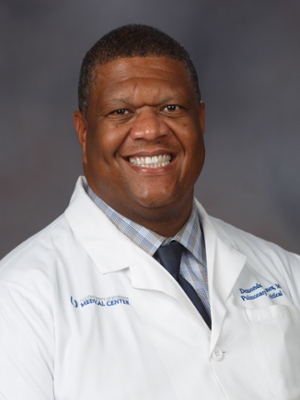
“For triplets to be here in this medical school together, I believe, is a first,” said Dr. Demondes Haynes, associate dean for admissions for the School of Medicine. “And to have two sets of triplets represented in the same class, I know that is unheard of.”
In reference to “two sets,” Haynes means that the Class of 2029 also includes Alexandra and Amelia Ladner, born together on June 30, 2002 with their sister, Julianna Ladner, now an advertising executive.
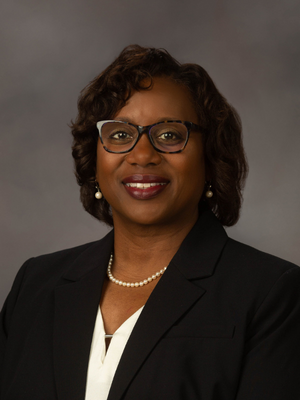
“It’s remarkable, first of all, that they all have an interest in medicine, which is not always the case with multiples,” said Dr. Loretta Jackson-Williams, vice dean for medical education, “and that they completed the admission requirements at the same time, which does not always happen.”
It’s hard to say exactly how rare it is for even one set of triplets to be pursuing an MD at the same time, in the same place and in the same class. The following statistics may have to do.
In 2023, the latest year available from the Centers for Disease Control and Prevention, the U.S. recorded 2,505 triplet births out of a total of 3,596,017: That’s one of every 1,435.5. Compare that to 110,393 twin births, or one of every 32.6.
Children from multiple births have unique problems, but also exceptional rewards. As the non-profit, Multiples of America, states on its website, a bond formed by two or more people with common experiences “is even stronger between individuals whose connection begins in utero, strengthens throughout childhood and lasts a lifetime.”
Amelia Ladner put it even better: “‘The Lucky Threes,’ that’s what I call us. Triplets do share a strong bond – maybe even stronger than a regular sibling or twin bond. It’s truly unbreakable. It’s like a circle.
“Anything in the world can happen and you will never NOT have it. And I know that must be true for the Bashas.”
‘Where’s the other one?’
In the 2021 graduating class of Lee Academy in Clarksdale, there were 30 students; 1 out of 10 was named Basha.
While being triplets sets them apart, it can also lump them together. “People tend not to look at you as individuals,” Michael said.
“If just two of us are together at one time, it’s: ‘Where’s the other one?’” Elizabeth said.
Clearly, each is a different person, said Haynes, who got to know them during the admissions process. “But they are all good students, and they’ve always been supremely nice. You can tell they had the same upbringing.”
Obviously, the Bashas are not identical, although Sarah and Elizabeth might be confused with each other by someone who’s not paying attention.

They do have mutual interests, though, particularly soccer, which they have played as teammates. Elizabeth and Sarah like working out and reading, while Sarah is also an artist who draws and paints portraits, particularly of her friends.
Like them, their brother is partial to pickleball. “But I also play the guitar, which annoys them,” he said with a grin that held more glee than regret.
Michael also stands alone among them as a lefthander. Most of all, he is the only one of the three born with hydrocephalus.
As a child, he was often in the hospital; at around age 6, he had surgery to treat the buildup of fluid around his brain. Doctors treated him so well, he said, that he decided to become one.
The fact that his mother is also a physician played a part, too, and this is especially true for his sisters.
“We meet people who say, ‘Oh, your mom took care of me and held my hand when I was in labor,” Elizabeth said. “To be with people in their most vulnerable state and have an impact that way must be so rewarding.”
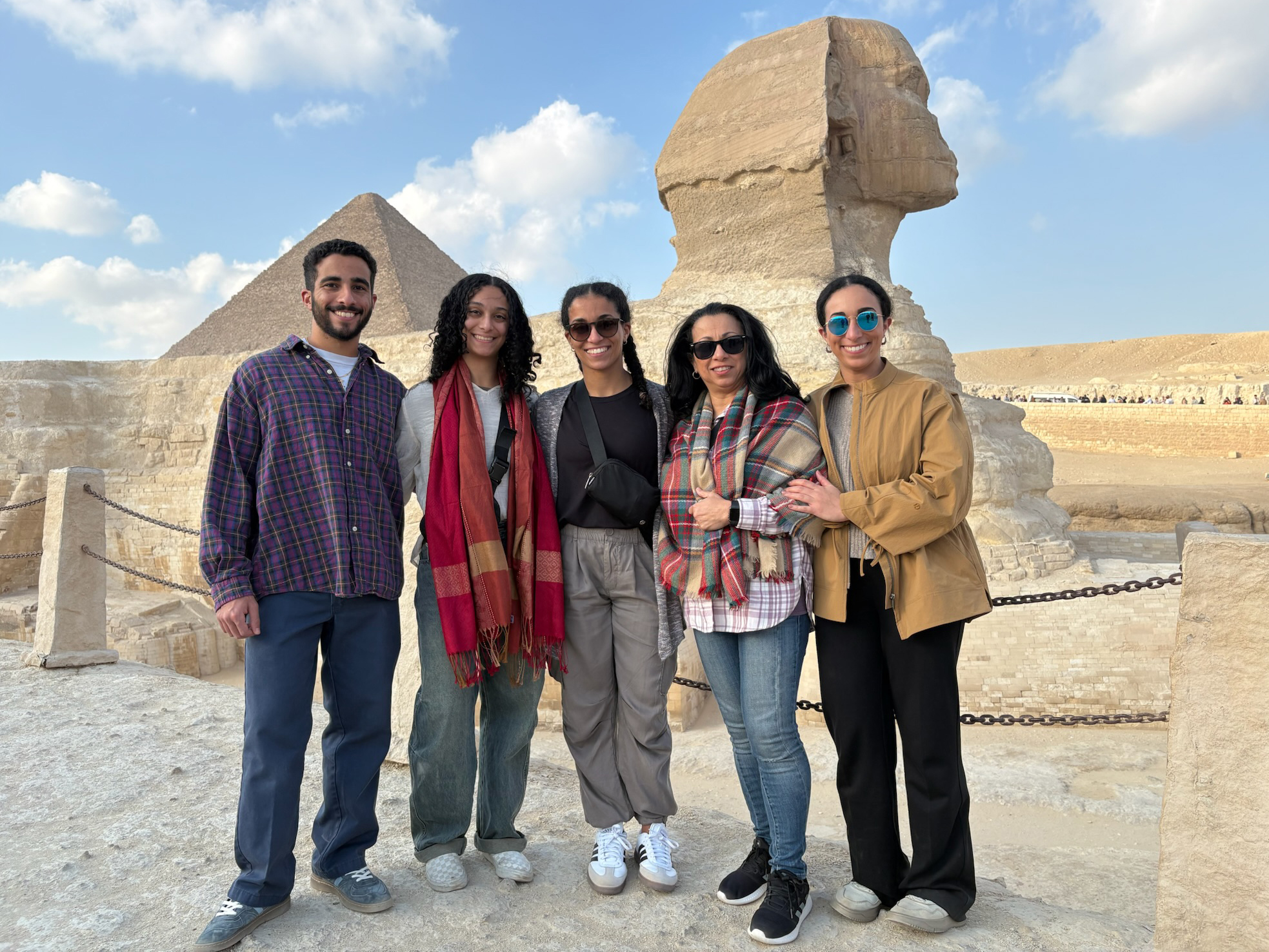
Originally from Egypt, Dr. Maha Wasef and Ashraf Basha, a construction engineer, moved to the U.S., first to California, then to Mississippi for Wasef’s residency in anesthesiology at UMMC. It was during her residency that the triplets were born and, at one fell swoop, the household grew nice and full with four children instead of just one.
For a while, the family lived in Corinth, where Wasef took her children with her to her doctor’s office and, in a way, revealed their future.
“She showed us that it was possible to work and have kids and be a doctor,” Elizabeth said.

The triplets were brought up mostly in Clarksdale, where, in high school, they excelled in the classroom and on the soccer field. Elizabeth and Sarah played on the school team, possibly befuddling opposing teams as they tried to mark
a player who seemed to be in two places
at once.
After high school, the three moved away to college, but not from each other. As students at the University of Mississippi, they lived in the same place in Oxford. But they weren’t the only set of triplets on campus. They weren’t even the only triplets with a parent who is a doctor.
They weren’t even the only triplets born to a doctor who trained at the Medical Center.
‘We made a connection’
For years, the Ladner triplets dressed alike; then, at around age 11, they put their feet down.
For the next 12 years or so, each made it a point to wear different clothes – until a day last year in August, when both Amelia and Alexandra put on a white coat.
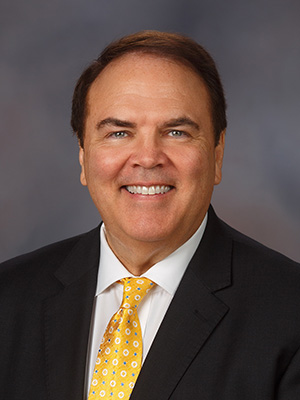
Their father, Dr. Mark Ladner, UMMC chair of psychiatry, was “ecstatic” about their resolve to become physicians, Amelia said, and he was among the proud parents present at the 2025 White Coat Ceremony in Jackson, which marked the students’ entry into medical school.
And, so, with three Bashas and two Ladners, the Class of 2029’s 170 students are 3% triplets – who have known about each other since college.
But it was in medical school that the Bashas and Ladners actually met each other and discovered their joint attraction to pickleball and multiples’ war stories.
“We made a connection,” Alexandra said.
As with the Bashas, the Ladners, including Julianna, lived together in Oxford, and stay together now in Jackson.
They, too, have an outlier in the group. Like Michael Basha vis-à-vis his siblings, Alexandra is the sole lefthander. Still, she and Amelia are taken with mixed-breed dogs – a cavapoo and a labradoodle, respectively.
And, like their father, they both enjoy meeting people, Alexandra said, and striving to make their day better. “We grew up with this image of our dad being kind to his patients.”
“That was because he was so kind us,” Amelia said. Every day, they saw him leave for work with his white coat in hand. They decided they wanted a coat for themselves.
Family tragedies solidified their decision while they were in high school: Their grandfather and an uncle both died from cancer.
“It was seeing how physicians treated them,” Alexandra said. “They were so compassionate, so kind and caring, and wanted the best for their patients.”
That’s exactly what patients can be expecting from Amelia and Alexandra one day, said Haynes, who worked closely with them while they were applying to medical school.
“They’re going to have a great bedside manner.”
That day can’t come soon enough for Amelia. “To be able to see people go through all phases of their lives,” she said, “to see them grow, to be able to hear their stories – who wouldn’t want to do that?”
‘There are no cons’
A medical student’s brain absorbs so much information, sometimes it must feel like trying to stuff an angry octopus into a sock.
But when you have someone at your side whose moods and movements are often synchronized with yours, the sock may feel more like a Christmas stocking.
“There are no cons to it – it’s like anyone else who has siblings in school with them,” Michael Basha said.
“It’s having someone always with you who understands how hard it is; it’s being able to always ask each other for help,” said Sarah Basha.
“Even in our residency,” said Elizabeth Basha, “we’ll definitely want to live nearby each other, especially if we’re having families of our own. We’ll still want to be around each other.”
“Maybe,” said Sarah Basha, “we can couples match.”