

MRI program marks 10 years of perfect pass rates
The health science program at the University of Mississippi Medical Center that supplies the health care workforce with those who take images of the body most vital to patient care marked a decade of excellence in 2026.
All students in the Masters of Magnetic Resonance Imaging program have passed the industry’s credentialing exam on the first try for all 10 years of the program’s existence.

“Our students having a 100% pass rate each of the past 10 years shows their dedication to the profession, first and foremost, and also the commitment of the Department of Radiologic Sciences to preparing future leaders in the medical imaging profession,” said Dr. Asher Street Beam, director of the program since it became a master’s level program in 2017. It began as a post-baccalaureate certificate program in 2014.
Housed in the School of Health Related Professions, the MSMRI program is the nation’s only accredited program offering a masters-level degree for MRI technology. The Joint Review Committee on Education in Radiologic Technology is the program’s accrediting agency. Exams are done by the American Registry of Radiologic Technologists.
MRI technologists are trained in areas essential to imaging procedures, including magnet safety, patient comfort, quality assurance and communicating with radiologists. A strong clinical education component inside an array of supportive clinical facilities provides students with unique opportunities to gain clinical skills on various types of systems.
Students often have a bachelor’s degree in hand prior to trying for their MSMRI. Each member of this year’s class earned bachelor’s degrees in the Radiologic Sciences program and work in the adult hospital as MRI technologists. Each will take registry exams next May, and clinical education in the program will guide future career decisions.
“Your clinical education in the program is like your job interview for future employment,” said Lauren Dungan, 22, of Grenada. “They’re going to remember you and how well you worked with the staff and equipment. You can then figure out where you’re going to work after graduation, whether it be at a hospital or a clinic.”
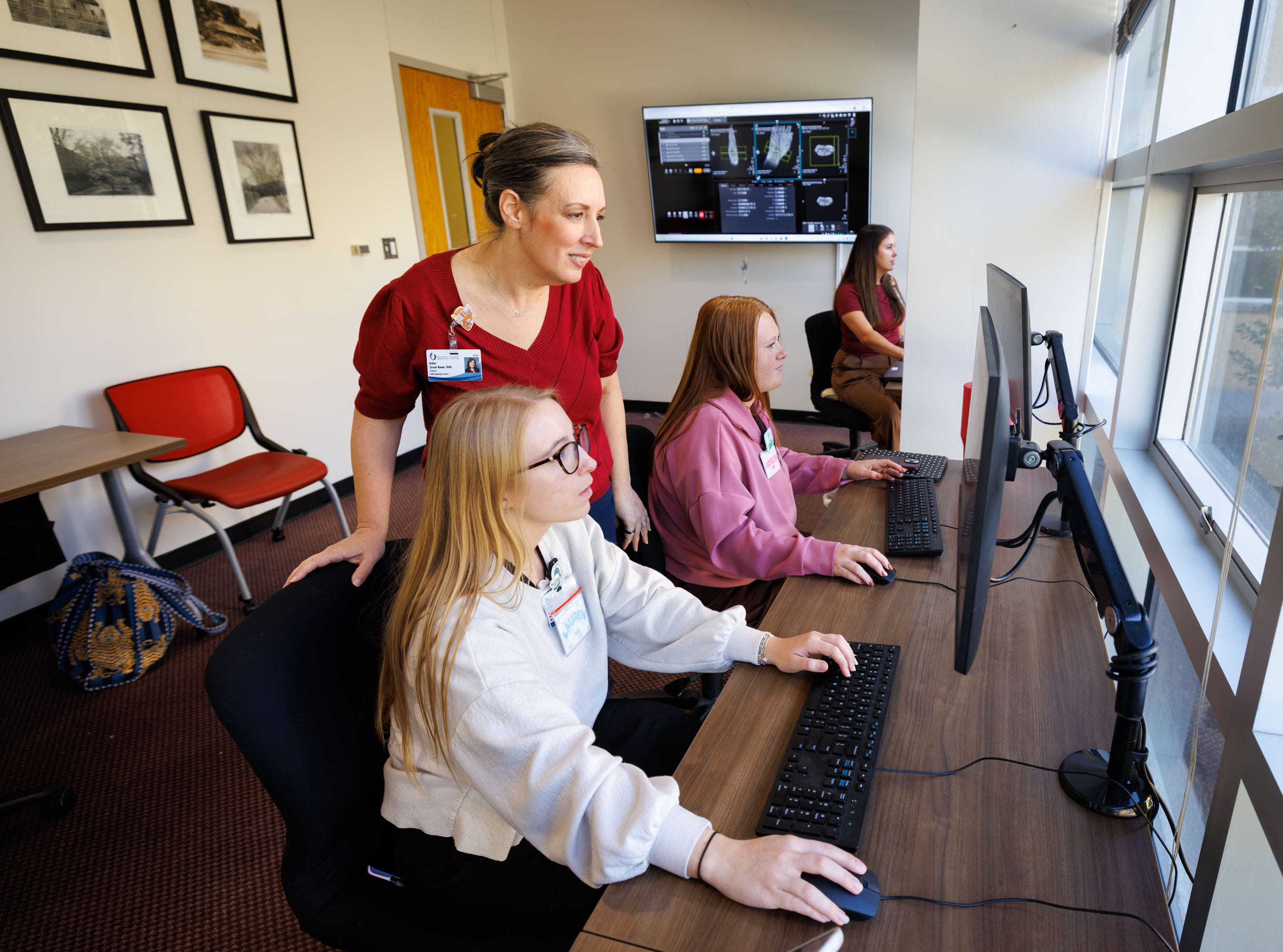
An advanced MRI simulation platform by SiemensSmartSimulator guides classroom instruction, helping to connect difficult scanning techniques and physics principles to real-world clinical applications.

“The simulator allows students to practice MRI examinations, ask questions, troubleshoot and learn at their own pace,” said Kala Burchfield, clinical director in the program. “It has strengthened their scanning skills and built confidence before entering the clinical setting.”
Jobs in radiologic and MRI technology is expected to grow by 5% by 2035, faster than the average for all occupations, according to the Bureau of Labor Statistics.
“It prepares us for jobs by giving us scenarios that simulate real patient experiences,” said MRI student Kate Dorman, of Newton. “We go through the various steps we can take if a patient has anxiety about having an MRI done, for example. It also prepares us for if a patient has a reaction to contrast dye.”
Ashlyn Bailey, of Terry, appreciates being able to work on the same platform she learns on as a student in the program.
“I’m definitely a hands-on learner,” Bailey said. “In class, I feel like it helps guide me through the curriculum so I can easily see how I can use it in clinicals.”
Faculty has incorporated their own experiences as MRI technologists to challenge critical thinking and problem-solving skills. The coursework presents several complex scenarios to solve, including a patient with an implanted neurostimulator requiring a lumbar spine MRI or with a retained bullet fragment without a previous imaging source available.
“As the founding program director, Asher has poured her heart into building this program into what it is today. Kala has been a wonderful addition to our faculty, bringing valuable clinical expertise and the same unwavering commitment to student success. Together, they are an exceptional team, preparing graduates with the skills, confidence and adaptability to excel in any MRI environment,” said Dr. Kristi Moore, chair of the Department of Radiologic Sciences. “I’m incredibly proud of their efforts and the program’s continued success.”