


Faculty spotlight: Buck Covington
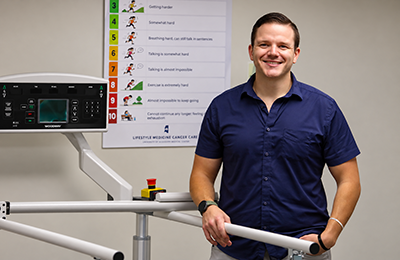
Buck Covington, PhD, has spent much of his career working toward a specific goal: bringing exercise oncology home to Mississippi. At UMMC, his work combines individualized cancer rehabilitation with research into how exercise can improve physical function, recovery and long-term health during and after cancer treatment.
1. What first drew you to exercise oncology, and when did you realize it was the direction you wanted your career to take?
I have always been interested in rehabilitation and helping people with injuries or chronic diseases. During my master’s program at Mississippi College, my advisor, Dr. Suzanne McDonough, introduced our class to exercise oncology and the work of the University of Northern Colorado Cancer Rehabilitation Institute. From that point, I began working toward joining UNCCRI with the goal of eventually bringing that knowledge and those services back to Mississippi.
That commitment became personal through my first patient at UNCCRI, Frank Gale. Frank and his wife, Kaye Firestone, showed me the responsibility and privilege of being part of someone’s life during cancer treatment. After Frank died, Kaye dedicated herself to helping other patients access the care that had meant so much to them. My continued involvement with the nonprofit Frank Gale Faith Not Fear reflects that connection.
Their influence, along with my experience at UNCCRI, solidified that this was the work I wanted to do.
2. How do you see exercise oncology fitting into cancer care and population health more broadly?
Exercise oncology is about caring for the whole person throughout treatment and survivorship. A person’s ability to work, care for family, remain independent and participate in everyday life deserves attention alongside the treatment of cancer itself.
Prescribed exercise can improve cardiovascular fitness, strength, physical function and quality of life while reducing fatigue and other treatment-related effects. The goal is not simply to give someone an exercise program. We assess where each patient is starting, prescribe exercise around the individual and their treatment and adjust that prescription as needs change.
At the population level, the opportunity is to make that support a routine and accessible part of cancer care. In Mississippi, we have the chance to build pathways that connect more patients with exercise, nutrition, behavioral health and medical care throughout treatment and survivorship.
3. What brought you to UMMC, and what opportunities did you see in Mississippi for this work?
Coming to UMMC connects directly to the goal that first led me into exercise oncology: bringing this care to people in Mississippi.
After completing my undergraduate and master’s training at Mississippi College, I earned my PhD in Exercise Physiology at the University of Northern Colorado, where I trained with Dr. Reid Hayward and the UNCCRI team. That experience gave me extensive exposure to individualized cancer rehabilitation as well as research into how patients respond to exercise.
At UMMC, I can bring that experience together with the expertise in Preventive Medicine and the cancer care and research taking place through the Cancer Center and Research Institute. Through Lifestyle Medicine Cancer Care, we have an opportunity to build a program in which clinical care and research continually inform one another and improve what we can offer patients across Mississippi.
4. Your research has examined muscular strength and the timing of exercise during cancer treatment. What questions are you most interested in answering now?
I am especially interested in why patients respond differently to exercise and what those differences can tell us about recovery. How do cancer type, treatment exposure and a person’s starting physical condition affect the adaptations they experience?
I also want to understand how changes in fitness and strength relate to fatigue, sleep, psychological well-being and quality of life. My research involving circadian rhythms and autonomic function gives me a foundation for examining some of the physiology behind those patterns.
Longer term, I hope to connect patients’ clinical responses with molecular processes such as epigenetic regulation and immunometabolism. Understanding those relationships could help us tailor exercise more precisely and improve long-term survivorship outcomes.
5. What do you hope to build or accomplish at UMMC over the next few years?
I want to establish Lifestyle Medicine Cancer Care as a strong clinical and research program serving more people across Mississippi. An immediate priority is expanding our ability to provide individualized, supervised exercise during and after cancer treatment and to give patients continuity as their needs change.
At the same time, I am building a longitudinal research foundation that will allow us to follow patients throughout survivorship and connect clinical outcomes with the physiological and molecular questions driving my research.
Ultimately, success would mean more patients receiving this care, meaningful improvements in their health and independence and research that helps us continually improve what we offer. I want people in Mississippi to have a greater opportunity to live fully during and after cancer and to use what we learn from caring for them to improve care for those who come after them.