


Postdoctoral spotlight: Hanqi Li
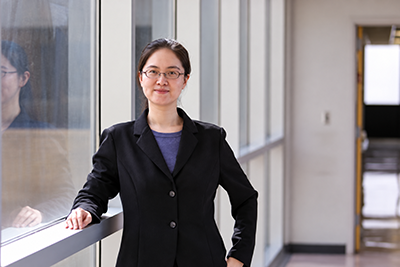
Hanqi Li, PhD, joined the Bower School of Population Health this fall as a postdoctoral research fellow in Preventive Medicine. Trained in geography, GIScience and spatial statistics, Li studies how place shapes access to health care – with recent work focused on obstetric services and current research examining access to mammography screening.
1. Your academic background is in geography. What led you from geography and GIScience to questions about health and health care access?
My background is in geography, GIScience and spatial statistics. I have always been interested in how spatial patterns shape people’s daily lives and opportunities. Health care access is a particularly meaningful application because where people live can significantly affect their ability to obtain essential services. I became interested in using geospatial methods to better understand these disparities and identify ways to improve access.
2. Your doctoral research focused on access to obstetric hospitals. What can geography reveal about maternal health access that traditional measures can miss?
Traditional measures often focus on the number of hospitals or providers within an administrative area, but access is more complex. Communities with similar numbers of nearby hospitals may have very different experiences because of travel distance, transportation networks, hospital capacity and demand. My doctoral research examined spatial access to obstetric hospitals and patients’ choices of delivery hospitals, with particular attention to how geographic access relates to actual health care use.
3. What attracted you to UMMC and Mississippi for your postdoctoral work?
I was drawn to UMMC because of its strong focus on population health research and opportunities for interdisciplinary collaboration. Mississippi is also an important setting for studying geographic and socioeconomic disparities in health care access. I hope to contribute my expertise in GIScience and spatial analysis while learning from researchers in public health, medicine and health services research.
4. How can geospatial methods help population health researchers identify communities that may be underserved or overlooked?
Geospatial methods allow us to look beyond administrative boundaries and examine access at much finer scales. We can use road networks to estimate actual travel times to health care facilities, then combine those measures with demographic and socioeconomic data. This can identify communities facing both limited geographic access and socioeconomic disadvantage – patterns that may not be apparent in conventional statistics.
5. What do you hope to accomplish during your time at the Bower School, and where would you like this line of research to lead?
During my postdoctoral training, I hope to strengthen my interdisciplinary research skills and develop geospatial methods that address important population health questions. I am currently exploring access to mammography screening facilities and how it intersects with socioeconomic disparities. Long term, I hope my work can move beyond identifying disparities toward practical, data-driven approaches that help researchers and policymakers make better decisions about health care resources.